
recycling a tree
Not all city trees are firewood.
I heat my house partially with a woodstove, and firewood isn’t cheap. Luckily, I use wood from my friend Brent, an arborist who, upon request, dumps trailers full of logs in my yard. He gets rid of excess wood, and I’m happy to take it. It’s a win-win situation, except I have to cut the wood to length and split it. A load dumped in my yard can, after cutting and splitting, contain a full cord of wood, sometimes more.1 I burn about two cords a season, usually ash2, maple, hickory, and once in a while some other wood like cherry or mulberry. Brent salvages some wood and has it milled into boards.
The Woodcycle also recycles urban trees and turns them into something useful. If someone has a tree trunk that’s straight and of a certain length, he’ll pick it up and saw it into lumber. A homeowner who’s forced to take down a large tree can have those logs custom sawn for their own uses. There’s a certain symmetry to taking down a tree that was threatening to crush your house at the next wind storm and turning it into flooring for said house. Several local government programs work with power companies and the Department of Natural Resources to make sure good wood isn’t chipped up for compost when it could be used for beautiful creations.
Unless it’s being sawn for a client, Woodcycle keeps the larger slabs for their own custom furniture business. The narrower pieces that aren’t commercially useful are donated to Restore, a shop run by Habitat for Humanity. I appreciate the wood, and a chance to recycle some wood on my own. You have to dig a little, but the good stuff is there if you get there on a good day and pick through it.
A family friend, David, built a cedar-lined chest from cherry he purchased as upcycled hardwood. I commissioned a Christmas present for Stephanie, who has three times as many sweaters as I have boats.3
David ran the boards through his planer to prepare boards for our project. If he bought finished cherry through a retail hardwood outlet, it would have been double the price, possibly more than that.
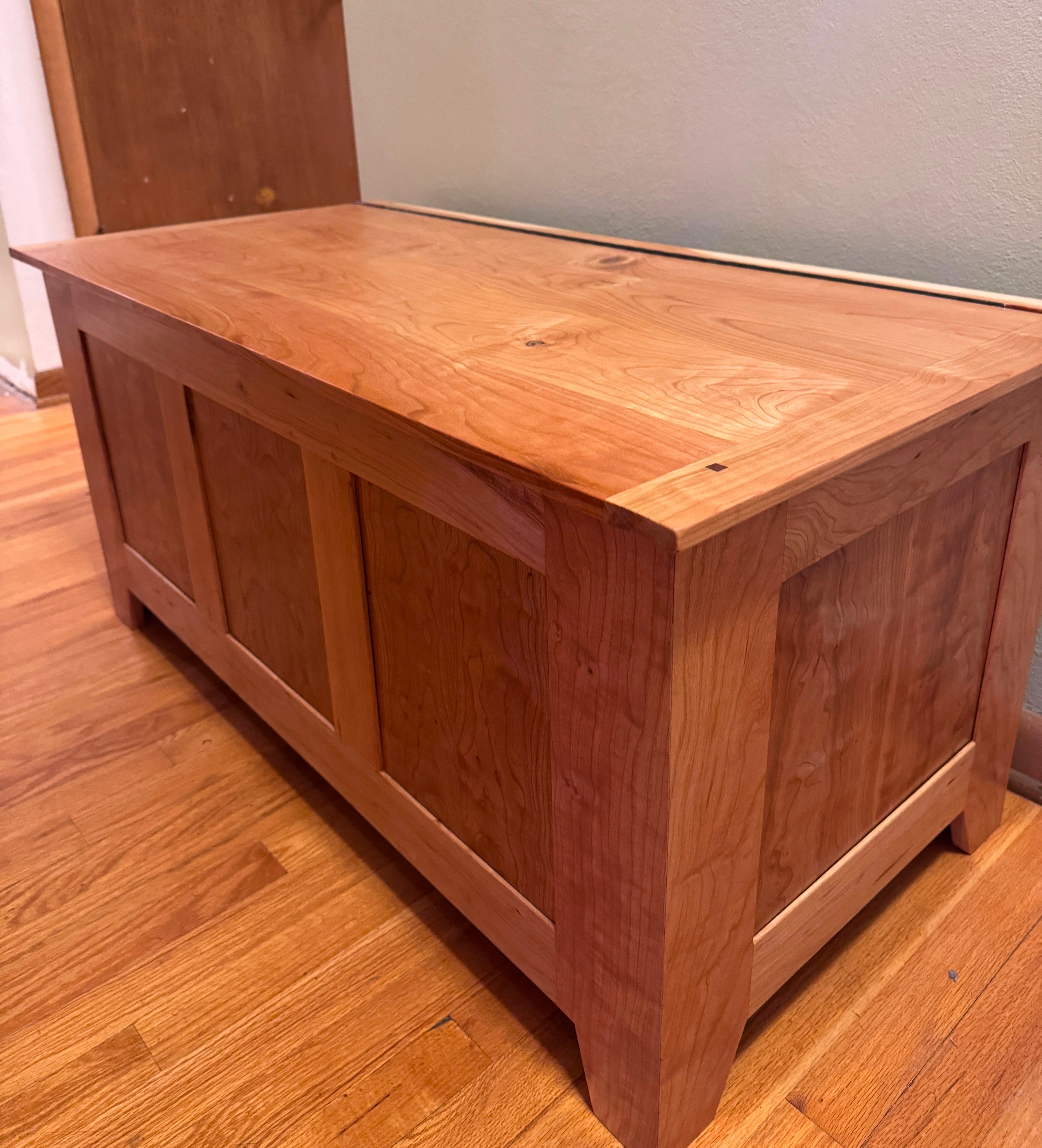
David is a masterful woodworker; I am a total hack. But I know how to cut, plane, rout, sand, and oil pieces of reclaimed wood. When it comes to joining two pieces of wood to each other, ask me to cut a dovetail and I’ll laugh at you. Ask me to cut a mortise and tenon joint, you’ll laugh at me. I can theoretically do it, but the joint will have more play in it than a sugared-up toddler. So I don’t.
I do have one exceptional talent: nicking a digit with sharp things. I do my best not to bleed on my work, sometimes unsuccessfully. So I limit myself to the greatest of all masterpieces, cheese boards. Anyone can make a rectangular prism.4
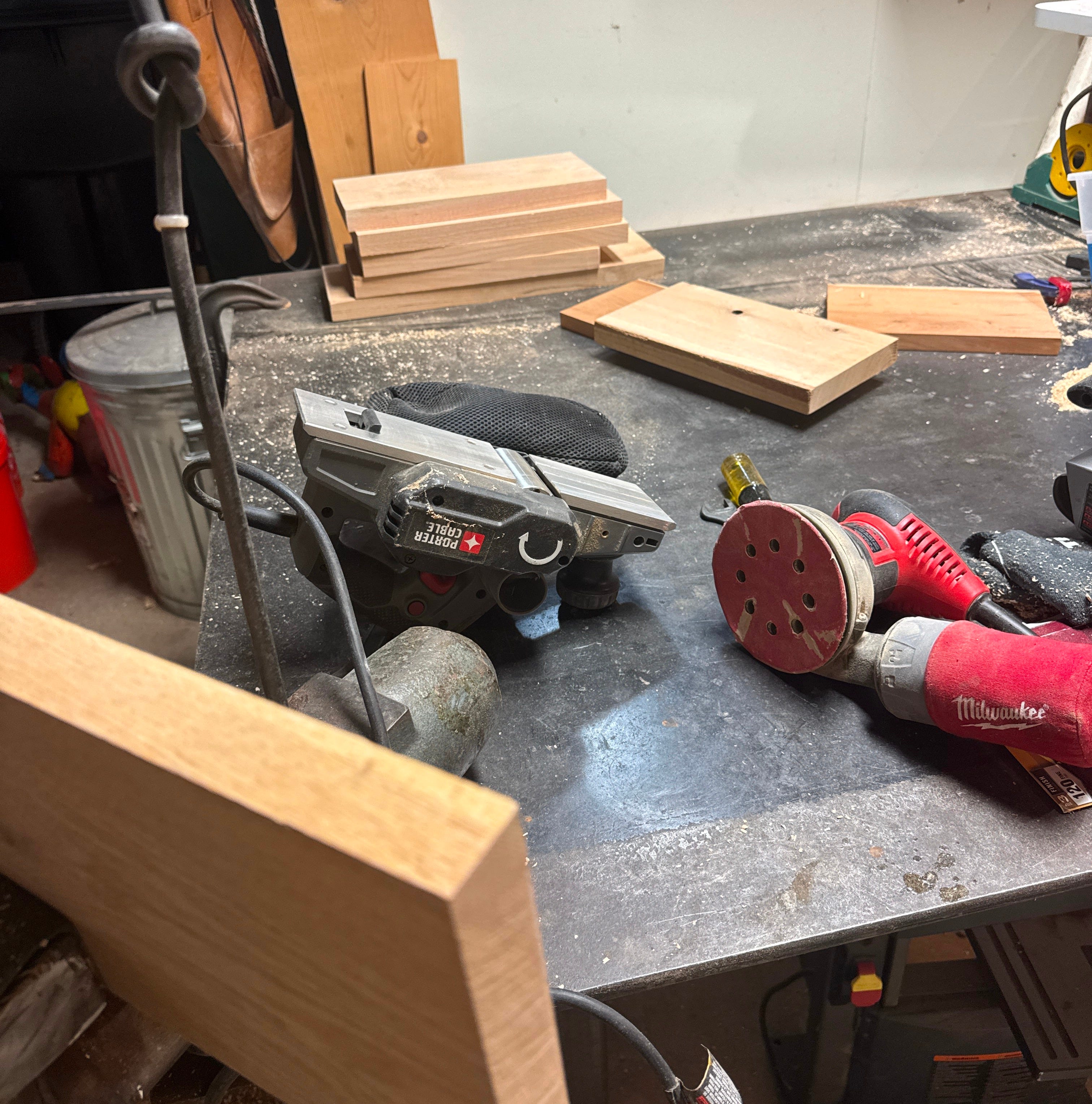
There is something satisfying about making something useful from what the sawyer considered scraps. It’s not worth it on a commercial basis to turn this lumber into anything, so they pass it along to people like me who don’t have to be efficient.
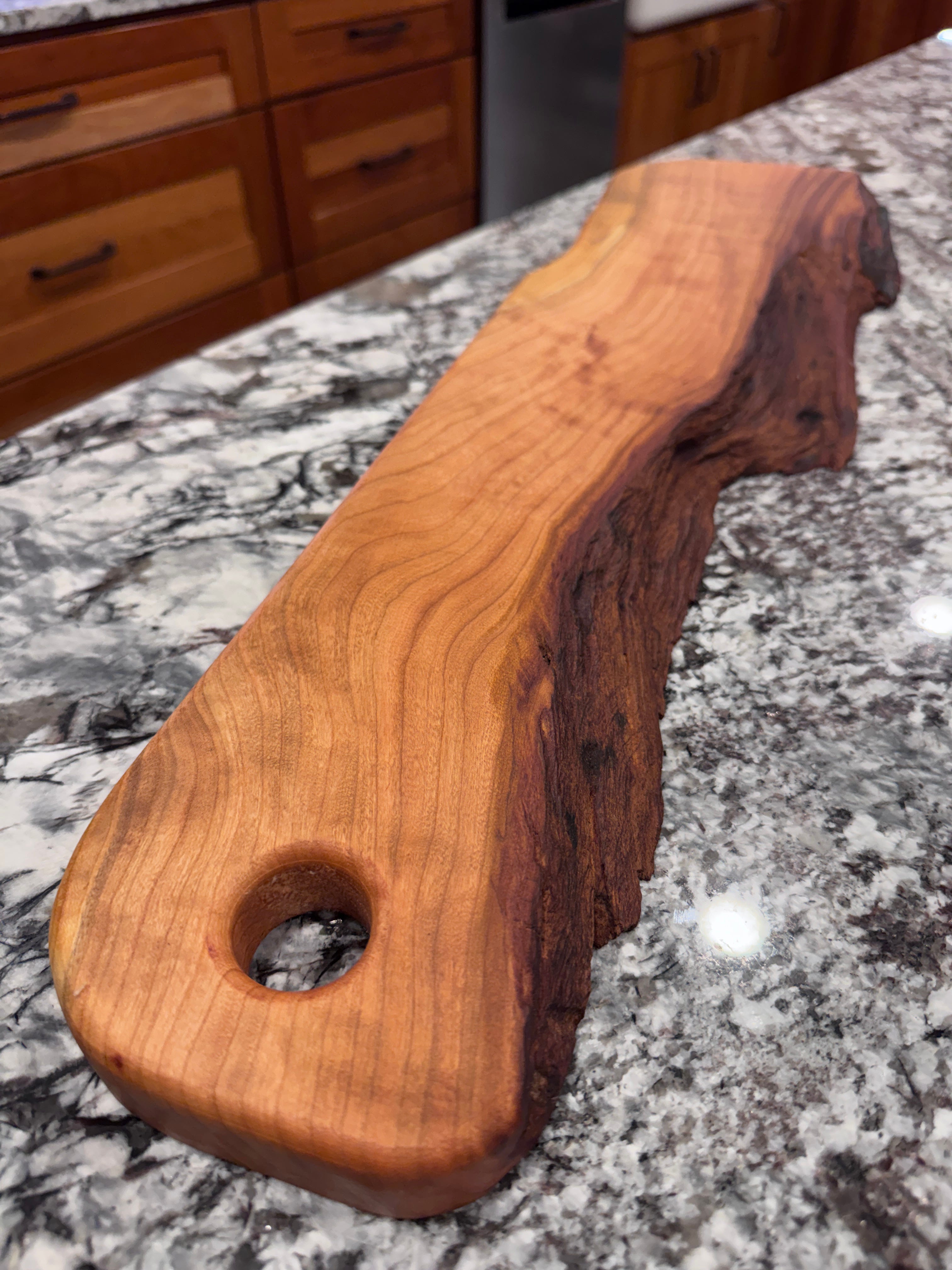
This piece of cherry was destined for the burn pile. Instead, I took a wire wheel to the edge that was rotten, and just brushed it lightly until the rotten and punky wood was gone. That left behind a beautiful edge that while useless for furniture, added some character. This scrap was transformed by me seeing it a little differently. I mean, what’s the harm in trying?
Turns out I got lucky. That wonky cheese board is already living in its new home in Milwaukee.
These boards will certainly be less dramatic than the cherry ones, but red oak is beautiful too. I have 14 blanks to be turned into finished boards, all from $44 worth of oak. I don’t know what a cutting board or cheese board goes for these days, but it’s more than $44/14. Or $22/7. Or as it might be, $3.15 a piece (rounded up because 22/7ths happens to be pi. Stephanie the math teacher was slightly amused.
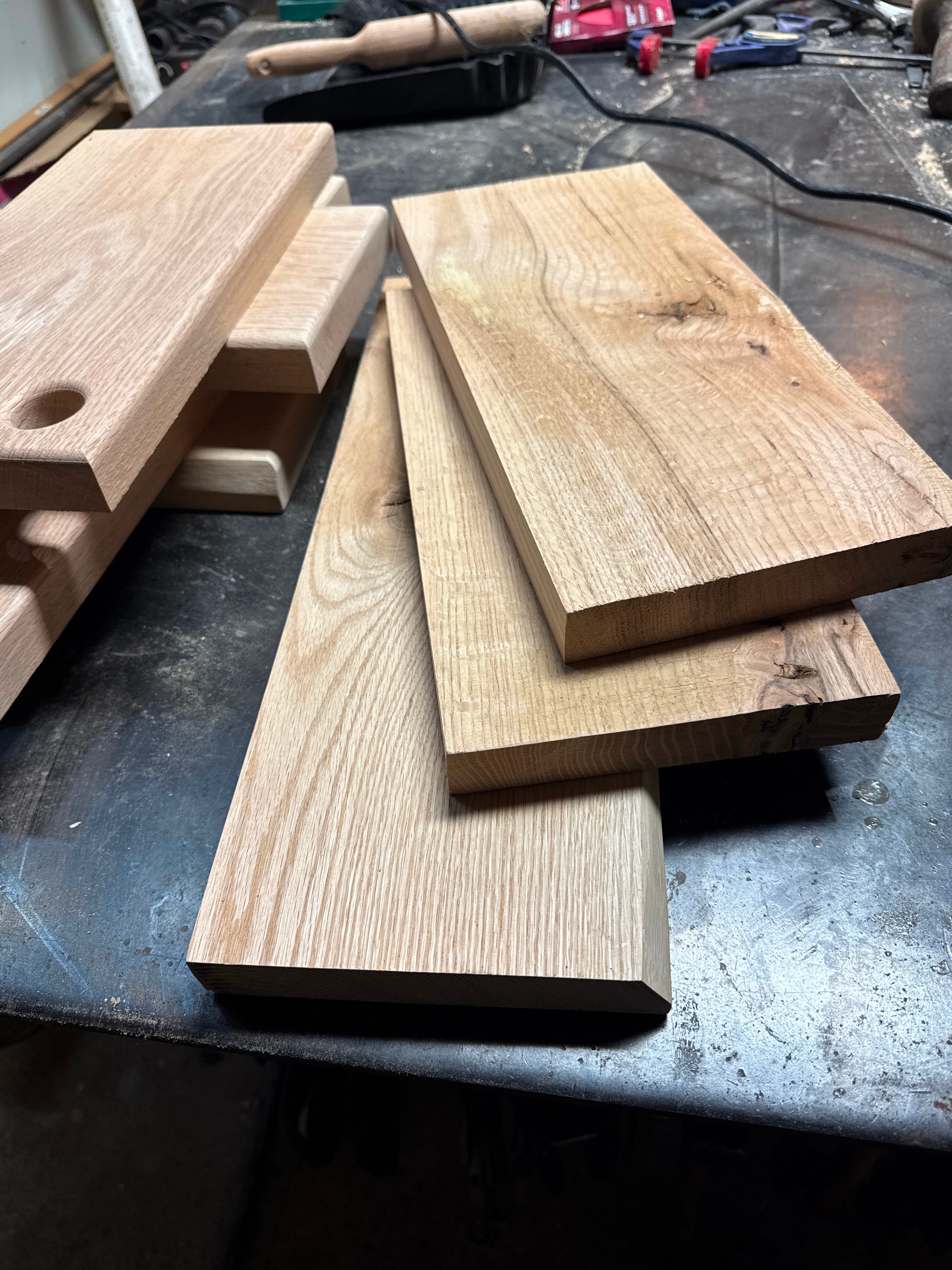
For a “handle,” I drill a hole, then rout and sand it to be smooth to the touch, so the user can hang it up if desired, and it also looks sorta cool. Simple is best, in my opinion.
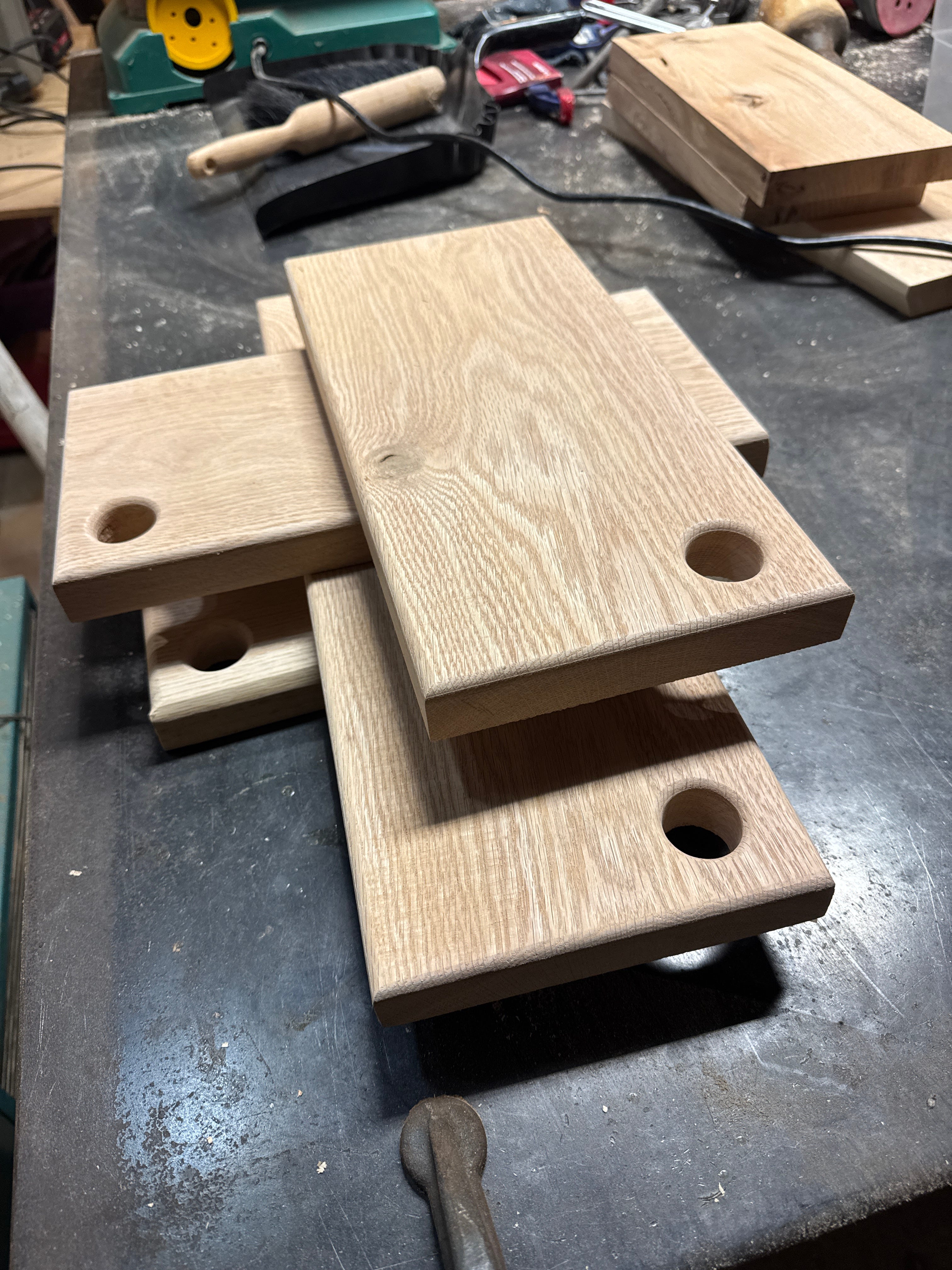
These are ready for oiling with a food grade finish that soaks into the wood and polymerizes. That means the oil molecules penetrate the wood fibers and interlock with each other to create a harder and less permeable surface. You don’t want a funky limberger to cross-contaminate your sweet Italian taleggio.
It has been a few days since I wrote the words above. I’m taking a break. Remember my exceptional talent? That Porter Cable power plane (sitting upside down in the second picture) has wicked sharp knives5 on it. I leave it upside down because then then the knives stay sharp, and sitting any plane flat on a table is bad form. I leave my non-power planes sitting on their sides for the same reason.
Even when not rotating at 16,500 rpm (whoa!), they’re still sharp, and I absentmindedly nicked my thumb on one of them. Oops. Nothing too bad, but it was right on an area I need to use without getting blood on my boards, so I’m waiting a few more days for it to fully heal.
I stopped by the Restore again, but there was no cherry to be had, and while I love working with black walnut for other projects, it’s not my favorite for cheese boards. There was hickory, but it was expensive and had a huge crack down the middle that would require epoxy, and that’s not my style. I’ll just be patient and wait for the right wood to speak to me.
When my thumb’s back to 100%, I’ll be back making cheese boards. Carefully.
A cord is, according to my sources, a 4’x4’x8’ rectangular prism.
Thank you, Emerald Ash Borer. You suck.
I gave David a budget guideline, and he blew right through it into the I-can’t-believe-how-beautiful-it-is territory. I added a few bucks to the agreed upon guideline, and I still think he barely made $5.00 an hour. I love David, and I’m grateful he didn’t follow my instructions.
Anyone can make a long, flat cube was the original sentence, until my math nerd wife said “This is wrong. It’s not a cube, it’s a rectangular prism. Cubes have equal sides.” I knew that. When I was in college.
Knives is actually the correct term for the blades on a planer. I don’t know why, but I have a hypothesis.
I'm glad to be a neighbor of The Wood Cycle and have sent there logs from several large walnut trees that I had to remove from my yard. I also volunteer at Habitat ReStore and Wood Cycle's "Urban Wood" is a very popular with customers (I'm delighted some included walnut boards milled from my logs). ReStore has a business relationship with Wood Cycle and purchases "Urban Wood", but currently the inventory is low because ReStore is a non-profit resale store and federal regulations no not allow more than 15% of sales to be from "purchased product", which includes "Urban Wood". If you cannot find the wood you seek at ReStore, an alternative is to visit The Wood Cycle (www.thewoodcycle.com) at 1239 South Fish Hatchery Rd, in Oregon, WI.
get yourself a lathe and you can do gear-shift knobs and other cool stuff! love cherry. maple too :)