
red admirals
Sweet water on the Sugar River.
The year’s at the spring, and day’s at the morn;
Morning’s at seven; the hill-side’s dew-pearled;
The lark’s on the wing, the snail’s on the thorn;
God’s in His Heaven — all’s right with the world!
—Robert Browning
If you love solo canoes like I do, it’s not easy to find a paddling partner. It’s a matter of demography.
Take the population of an area—in my case, Madison, Wisconsin. Three or four hundred thousand people, with lots of paddlers. A good start, but we start to thin the herd quickly.
In our population, there are a limited number of people who actually know how to paddle a solo canoe. Not just get in it and figure it out as they go along (which is a recipe for disaster on small, swift creeks), but actually know how to make a solo canoe go where they want it to go without too much effort or swearing. Maybe there are 500 or so solo canoeists in Madison.
Of that 500, maybe half of them own a solo canoe or can borrow one from a friend. Those of us who paddle solo canoes are somewhat stingy about loaning them out. So we’re down to 250.
Roughly half of those 250 are loners who love to paddle alone. Fine, let ’em—I feel the same way often enough. So that gets us down to 125. Of that 125, I might have the phone numbers of 50 of them.
Now we need to find someone who is willing to blow off work on a Friday afternoon to paddle, on pretty short notice. Because most solo canoeists have their priorities in order, that’ll knock out about three people. So we’re down to 47.
Of that 47, about 25 of them like to paddle really fast. Not a problem: again, paddle and let paddle. I just like to go slower, stop and smell the roses, enjoy the birdsong and wildflowers. So we’re down to 22. 22/300,000. The odds are not in our favor. But it’s not just about ratios and populations. Solo paddlers are a different breed.
A few years ago, I emailed Doug a week before my intended work-skipping delinquency and told him I was taking off Friday afternoon and asked if he’d like to go for a quick paddle on the Sugar River. His response: “What a great idea. Sure.”
I pulled out the gazetteer and photocopied a map of the upper stretches of the Sugar River, a lovely little stream 20 miles southwest of Madison in the appropriately named Green County.
Settled by Swiss and German immigrants, Green County has little development that is not agricultural. Neat, well-kept farms dot the rolling landscape, and the towns are full of signs of Swiss and German heritage—restaurants with Haus as a suffix and bakeries with wonderful goodies straight out of Bavaria or Glarus. Most of the menus have multiple meals with wurst, and cheese outlets sell monstrous bricks of the stuff at ridiculous prices. Unless you have ten kids, I can’t imagine what I would do with an eight-pound block of Muenster cheese, which I am sure the TSA would regard as a weapon. But I digress.
I often photocopy maps to take on river trips, which I carefully enlarge or reduce so that the scale is appropriate. I then feed them into the sheet laminator at work so they’re waterproof and easy to write on with a grease pencil, should I want to make notes (i.e., “Log jam, portage on the left” or “Lots of damselflies here.”). I often don’t follow it, but it’s a ritual that allows me to enjoy the anticipation.
The rest of the gear was easy. It was a day trip, so just a few bits of safety gear in a thwart bag, a water bottle, some snacks, a few paddles, and a PFD, and I was ready to go.
We got to the designated put-in as a couple of locals were putting their kayaks on their car. They were damp, happy, and pleased to give us a report on the river. From these gentlemen, we learned that someone had cleared out the downfall upstream for many miles, something that had not been done for years.
Cool. Next trip, maybe.
We ran a short shuttle and were on the water quickly, the noise of the road fading as we sorted our way through the fallen silver maples that clogged the first few hundred yards. The current was pleasant, not pushy, and although we had to paddle, there wasn’t much need to paddle fast.
Besides, people who paddle fast need professional help. My racing friends disagree with me, and that’s fine.
Paddling with Doug is a pleasure. While not an introvert, he’s also not a prattler. He’s comfortable with silence and doesn’t speak unless he can improve upon it—a skill and characteristic that is far too uncommon among our species. He takes Isaac Walton at his word: Study to be quiet.
We drifted along, enjoying the birdsong and the occasional mélange of barnyard fragrances mixing with the scents of wildflowers. It sounds vile, but it’s actually quite pleasant and, for me, evocative of the dozens of small streams that riddle southwestern Wisconsin.
My phone rang, and to my shame, I answered it. Hello, this is Darren…
I don’t remember what it was about; that’s how unimportant it was. Within a few minutes, I solved the problem. Doug paddled up next to me.
“How did you do that?”
“Do what?”
“Paddle through those logs paddling with one hand.”
I guess I didn’t realize I had done that. I thought about it for a second and realized that I had stuck the top grip into my armpit and sculled to move around.
“I dunno. I just did it.”
Doug is a psychiatrist. He’s been a store customer and paddler for decades, predating my ownership. He also is the one who diagnosed me in the parking lot of the shop. He didn’t tell me at the time, but later we visited and he put me on meds for depression a month or so later.
I asked him later how he knew. He said, “I don’t know. I just knew.”
One of my canoe coaches told me that as an instructor, I’d have students go through four stages of learning:
Unconscious incompetence: You don’t know what you don’t know.
Conscious incompetence: You now know you don’t have the skills you are seeking.
Conscious competence: You can do the skills, but you need to think about it.
Unconscious competence: You don’t have to think about it; it just happens.
My experience is that students either arrive between stage one and two, and after a few minutes, they quickly learn they are clueless. I once had a youth leader who had been paddling for over 25 years. I gently (no, really) explained that paddling for 25 years isn’t the same as paddling for a year 25 times in a row.
My experience is also that there’s a short gap between stages two and three, if the student applies themselves to learning. Three to four—that takes a lot of time and practice and just hours in a boat. Same with driving, flying, and any other activity that requires unconscious competence. You do not want a pilot who has to think about how to do a complicated approach and landing; you want muscle memory to do most of it, leaving their brain to handle the tricky stuff.
You want a surgeon who doesn’t think about how to slice you open as if it were the first time. And you don’t want a psychiatrist who’s just throwing things against the wall to see if they stick. Doug had been diagnosing mental illness so long that he saw something in my behavior that a person with less training might not see, and luckily, he was right. How did he know? He just knew.
If you’re reading this, you have an “I just knew” talent. When you do something long enough, it becomes unconscious. My wife can knit with multiple colors and patterns and stitches while making a sweater. It astounds me. My professional photographer friends see things differently than I do, and the difference between a good photo and a great photo is the last little bit of instinct.
As we pondered these ideas of consciousness, a huge swarm of Red Admirals showed up.
Red Admirals are fairly common butterflies in much of the upper Midwest. They have a cycle much like the rest of nature, where you can go years without seeing a few dozen of them, but suddenly the cosmic tumblers line up and, blammo, you have an explosion of butterflies that is almost a nuisance. Almost.
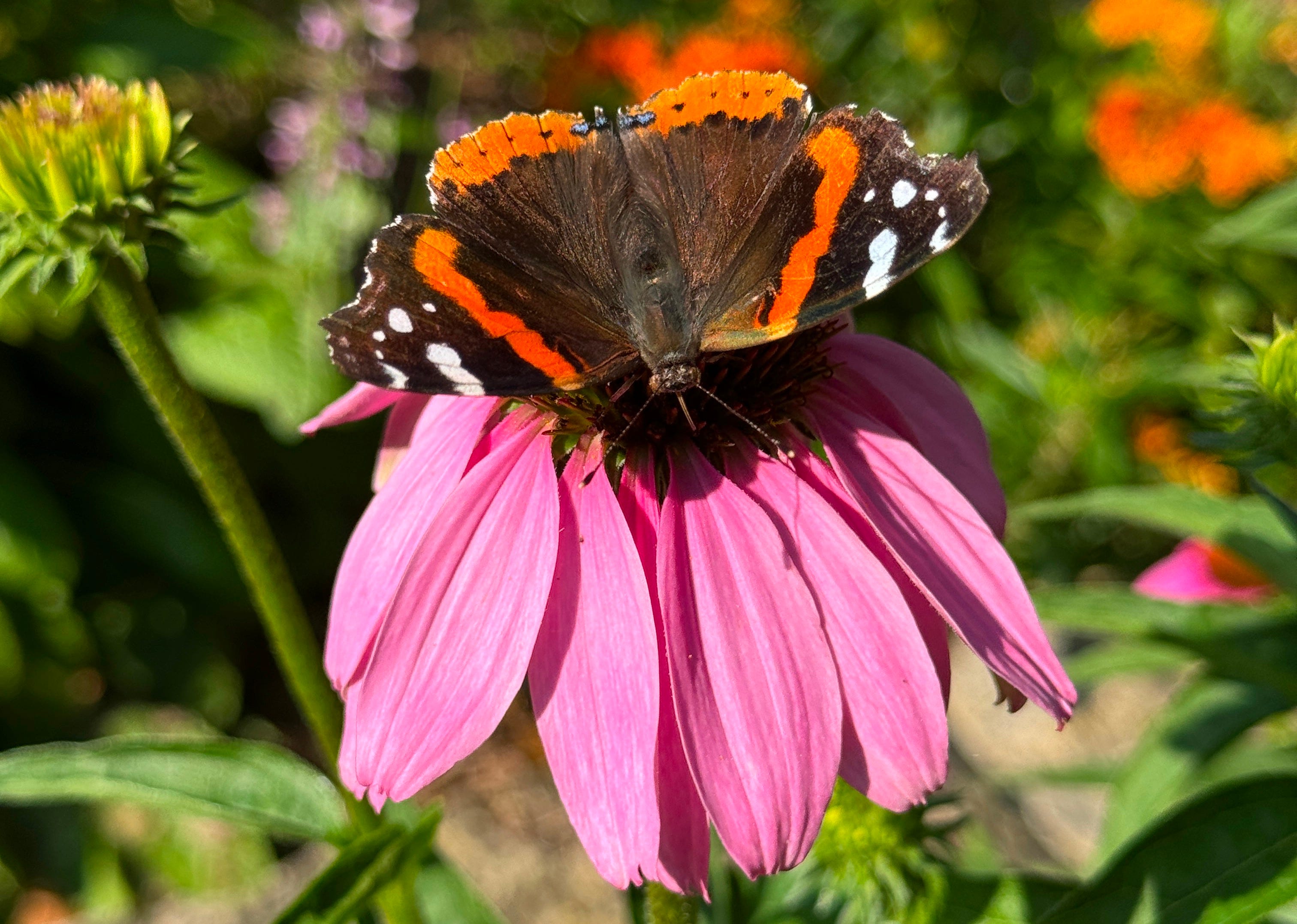
Red Admirals were landing all over my boat, my hat, and sometimes on my paddle, strangely enough. They were fearless, or at least unconcerned with their impending doom should one of them land on my gunwale and get caught between the boat and a paddle shaft. Red Admirals were everywhere.
If Hitchcock had wanted to shoot a horror film called The Butterflies, all he would have needed is Tippi Hedren and a canoe or two. If Red Admirals were bloodsuckers, I would have gone mad like one of those caribou in ANWR who suddenly goes postal from the bazillion mosquitoes whose hum of 100 dB would break anyone’s will to live. It’s like floating in the Amazon River, except the piranhas are much smaller, much more numerous, and able to fly.
Had Nature been endowed with a sick sense of humor, I no doubt would have arrived at the takeout a shriveled husk. As it is, we both knew the butterflies were harmless and just enjoyed their companionship. Hitchhikers welcome. Climb on—I was going that way anyway. No, I don’t need gas money, thanks.
The day was already close to perfect. Larks and snails were on wings and thorns respectively, and all was indeed right with the world. Sure, there were plenty of things in the news the morning before and the evening after our paddle that would indicate that Browning was an ignoramus. Wars, famines, political machinations that turn the stomach, and various schemers and crooks: the list can—and does—go on and on.
But for the three and a half hours Doug and I paddled the sweet waters of the Sugar River, all we knew was peaceful water, gregarious butterflies, rich conversation, and convivial friendship.
Doesn’t get any better than that.
I have an acquaintance who has lepidopteraphobia - I won’t share this with her. But, from my perspective, this was lovely. Thanks!