
profanity vs. vulgarity
Words are important, so let's use them properly.
“You are going to feel like hell if you never write the stuff that is tugging on the sleeves in your heart… your truth, your version of things, in your voice. That is really all you have to offer us, and it’s why you were born.” - Anne Lamott
I gotta write this stuff. Read it if you want to.
I was commenting to friends on a certain person in our current political maelstrom, and I used a work that many feel vulgar. It is vulgar.
What it is not is profane.
Many people use those terms interchangeably. They are totally different words with totally different meanings.
Vulgar is from the Latin word vulgaris, which means “of the people,” that is, common. Romans spoke vulgar Latin, almost unrecognizable from the literary Latin used by writers in the Roman empire. The Latin bible, the Vulgate, comes from being in a vulgar (common) language.
Vulgar is a value-neutral adjective. It only became more meaningful as a pejorative in recent centuries, especially as wealth discrepancy led to class distinctions (us rich folks vs. the vulgar, common classes).
Profanity, that’s different. That’s from the Latin word profanus, or not holy. That has evolved to mean language that is disrespectful of deity. Sacred and profane are antonyms.
Obscenity is another matter altogether. More Latin; ob (in the front of) and caenum (scum, filth, icy, etc.). That one was litigated, when dealing with First Amendment rights with regards to pornography, which elicited the famous comment of Justice Potter Stewart. He couldn’t define it, but he “would know it when I see it.” They tried to define it as “anything patently offensive, appealing to prurient interest, and of no redeeming social value.” Some folks think that much of Renaissance art is obscene. Those people are unenlightened.
After Michelangelo painted The Last Judgment in the Sistine Chapel, a prudish Papal legate, Biagio da Cesena, complained about the nudity, and hired Daniele da Volterra to put “draperies” over the genitalia of the figures. Fortunately, the draperies were removed in later restorations. Side note: Pope Leo X was not at all pious, a Medici by birth and a lover of the finer things in life.
Yeah, obscenity is still legally problematic, but I guess I look at obscenity as something I really don’t want around me. My test is when I walk out of a film or play because it gives me the icks, another great legal term. For me it’s not so much nudity as cruelty or violence. I walked out of the play The Mill on the Floss (adapted from George Eliot’s novel). Not because people were running around nude on the stage, but because there was immense cruelty. That is what is obscene to me.
Anyway.
Then there’s piety. A problematic word, since some use it to mean someone who is truly pursuing a virtuous life, particularly in reference to religion. Others use it as a negative epithet, such as Frederick Douglass describing a slave market.
The slave auctioneer's bell and the church-going bell chime in with each other, and the bitter cries of the heart-broken slave are drowned in the religious shouts of his pious master. Revivals of religion and revivals in the slave-trade go hand in hand together.
Here, I think, Mr. Douglass was clear in his definition.
Then there’s my hero, Dietrich Bonhoeffer, hanged by the Nazis 11 days before Flossenberg Concentration Camp was liberated by the US troops.
The pious fellowship permits no one to be a sinner. So everybody must conceal his sin from himself and from the fellowship. We dare not be sinners. Many Christians are unthinkably horrified when a real sinner is suddenly discovered among the righteous.
I try my best to be holy, but I am not particularly pious. I love that holiness comes from an Old English word (halignes) meaning whole or sound (like a horse in good shape is sound). I try to be whole and sound. I believe humans should strive for that sort of wholeness. I could venture off into integrity (being whole), but I won’t. Today anyway.
Admitting to your flaws (or sins to follow Bonhoeffer) sure makes it easier to handle them. Covering things up just makes them fester; better to get it out there. Orthodox Christianity has a prayer: Lord Jesus Christ, Son of God, have mercy on me, a sinner1. I’m not Orthodox, but I like the idea, Christian or not, of stating Okay, I’m a mess, but I’ll take the mercy, please.
Now let’s take it from theoretical to practical.
A few years ago I was in Rome with Stephanie and two other couples. It was a wonderful trip, and our friendship grew closer over our time together. They are still some of my best friends, and always will be. I love them like siblings.
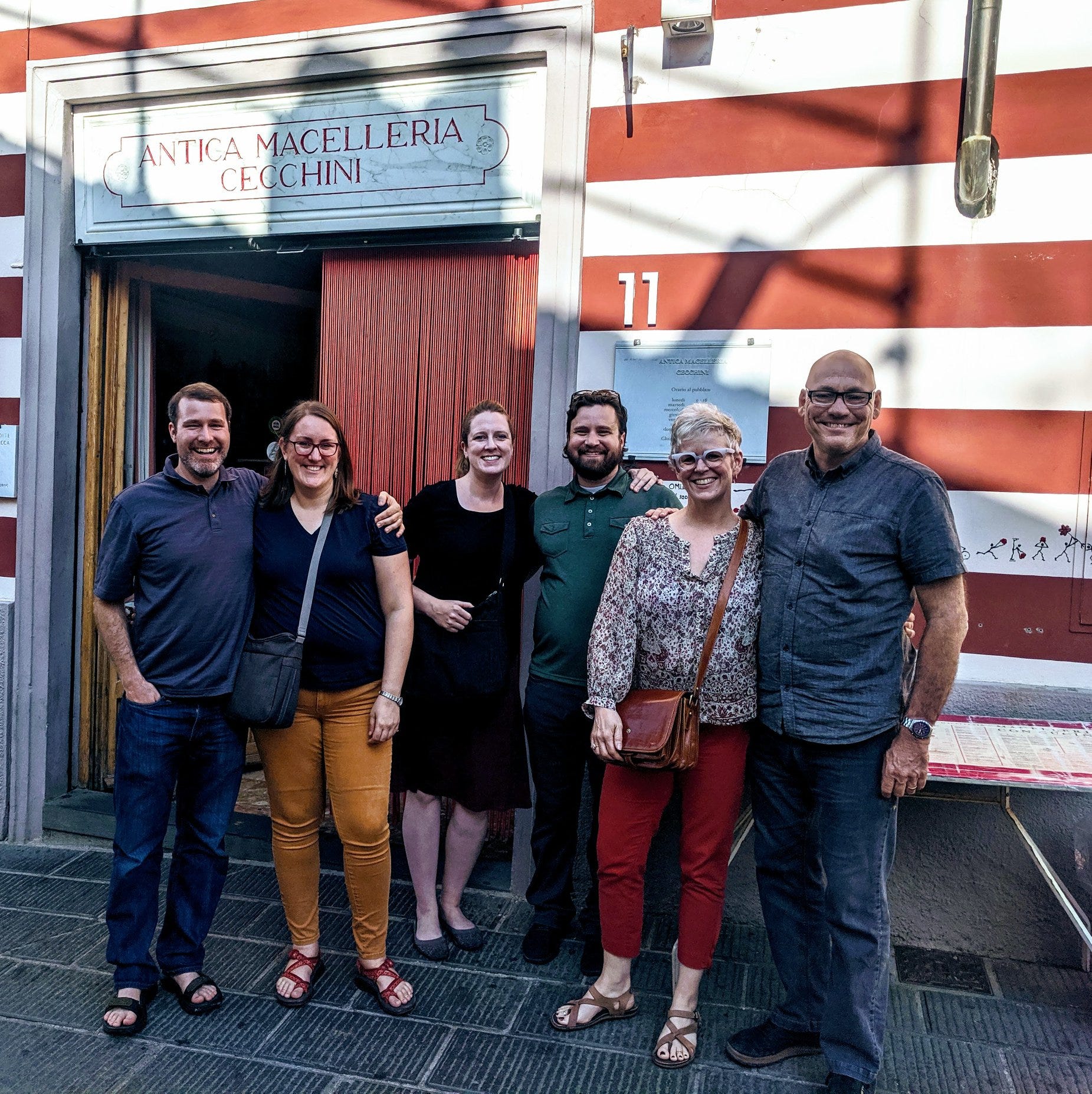
We were all starting to fade a little, so we sat down at a restaurant in the Jewish Quarter which looked like it had the good stuff, and they could seat six. We got our menus and ordered rapidly. Then the clock started. 30 minutes went by. 45 minutes went by. Couples around us who came after us were being served.
The waiter was dismissive and rude when we asked for an update, as if we were disturbing him. He dropped a dish we hadn’t ordered in front of one of us, and ten seconds later grabbed it and put it on a next table. Our wives were feeling weak and needed food. They get tired; I get angry when people are rude.
I finally stood up and marched toward the waiter, pinned him in the corner of the patio, and said (in Italian) “Look, we’ve been here for almost an hour. We need food, e non me ne frega un cazzo where we get it, from here, or from somewhere else. So what’s it going to be?”
You can look up the phrase or just trust me, it wasn’t a polite phrase. He was mortified. Pearls were clutched. Signore, per favore! I don’t think he expected fluent Italian, let alone some vocabulary not typical of Americans.
Vulgar? Totally. Profane? Not at all. Pious, well, um, also no.
Funny thing. Someone asked me after hearing that story if I would talk like that around Jesus. Aside from the hypothetical absurdity, the idea of eating at a good restaurant in Rome with Jesus would be awesome. I said I wouldn’t, but not because of the words, but because of the meanness behind the language. I was embarrassed later, not because I used a 5-star vulgarity, but because I was cruel, and directed all that wait time and frustration at a man who was probably doing his best with a bad kitchen staff.
So not my finest moment. I would go back and apologize if COVID hadn’t killed that restaurant. Well, maybe COVID and rotten service. We’ll never know. What I do know is that our food came out shortly after my ill-tempered soliloquy.
Words don’t bug me, really. Violence, that bugs me. Wrath, that bugs me. I was frustrated and unkind. Well, no. I was mean. Angry. Wrathful.
I remember when our governor said something the state legislature was cooking up some nonsense that would definitely hurt people, particularly the poor. Governor Evers called it a load of bullshit, which it was. The pious, sanctimonious, and hypocritical members of the state Assembly were too much for me. They acted like the Governor had just kicked a puppy. Not soon after that, one of the indignant legislatures was caught on an open mic saying far worse. Far. worse.
Of course, the bill was bullshit.
My grandfather Henry Ray Bush started working on the railroads when he was 8, and at 13 he started swinging a spike maul with an 8-pound head. He and his brother, my great uncle Karl, were not people who suffered fools lightly. In the railroad gangs, fistfights were not uncommon when someone stepped out of line. According to Grampa, Uncle Karl never lost a fight, and I believe it. The last words Uncle Karl said to me were “Well, Darren, stay out of the damn pool hall.” Then he crawled back under the hot rod he was working on with one of the neighbor kids. While he was dying of cancer.
Those men were never, ever profane, and they were certainly not pious. They were two of the best men I ever knew, particularly Grampa.

I am wearing a wedding ring from September 3, 1929. That’s the date my grandparents were married. I gave my original wedding ring to a future son-in-law, to be resized and to pass it along with some family history. My ring, now almost a century old, means more to me that any possession I own. Grampa was a saint. Not a pious one, but one who showed love by action. I learned to be a good husband from watching H. Ray Bush, vulgar as he was.
Domine Iesu Christe, Fili Dei, miserere mei, peccatoris. I like it better in Latin.